 Griffin Golf Cart Repair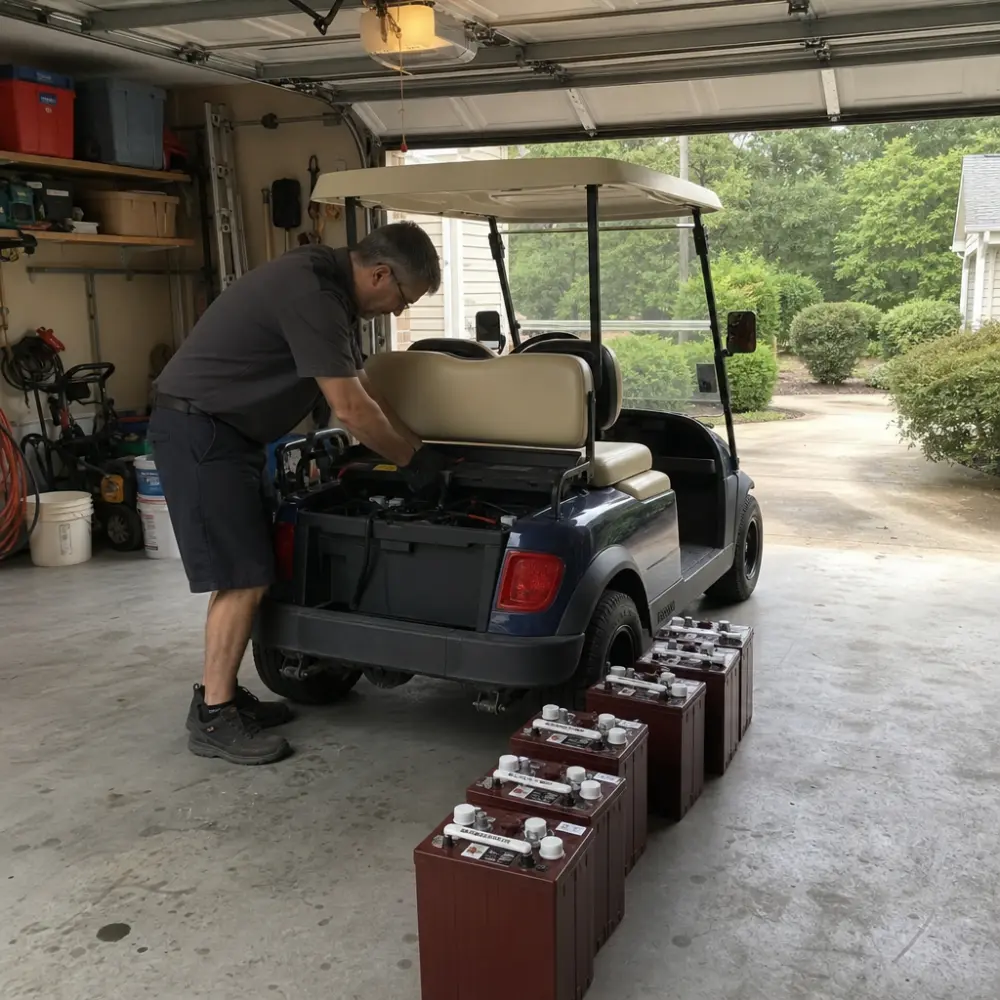

Griffin has written golf carts into its city code. Under Ordinance 22-05, adopted July 12, 2022 to replace an earlier 2016 version of the same article, a registered personal transportation vehicle (PTV, the legal name for a street-driven golf cart) may use city roads posted 35 mph or less, provided the cart carries a list of equipment the city spells out and its headlamps and tail lamps are on the whole time it is on a public road. About five miles north-northeast of downtown, in unincorporated Spalding County, Sun City Peachtree runs under a different rulebook: the county’s own motorized cart ordinance. Either way, the repairs that keep a cart legal and running come from the same short list: brakes, lights, a horn, and a battery pack strong enough to run the lights and the drive motor together. That is the repair work this site covers, done at your house so the cart never needs a trailer.
Which rules apply where your cart lives
| Where the cart is kept | Rulebook | Key points |
|---|---|---|
| Inside Griffin city limits | Code of Griffin, Chapter 90, Article XI | Register with Griffin Police, $15 a year; roads posted 35 mph or less; head and tail lamps on at all times; valid driver’s license |
| Sun City Peachtree and other unincorporated Spalding County | Spalding County Code Sec. 7-1013 | Streets and paved paths in active adult, village node, and planned residential districts; county registration (the code lists $25 a year; confirm with the Tax Commissioner); licensed drivers over 16; no carts on Jordan Hill Road or Highway 155 except at designated crossings |
| Hampton, Locust Grove, Zebulon, Barnesville | That city’s own code | No cart ordinance turned up in the Hampton or Locust Grove codes, Zebulon’s could not be searched, and Barnesville was drafting one in 2026. Ask the city before driving on its streets |
| A golf course, on the course | The course’s rules | Georgia’s O.C.G.A. 40-6-331 and Griffin’s Sec. 90-212(c) exempt course-owned fleets used only on the premises |
Georgia’s state law, O.C.G.A. 40-6-331, is what lets a city or county designate streets for PTVs in the first place, and it requires every PTV driver to hold a valid driver’s license unless a local ordinance allowing unlicensed drivers was on the books before January 1, 2012. The full breakdown, including the seven approved crossings in Griffin, is on the street-legal rules page.
What gets fixed at your house
- Mobile golf cart repair: the cart will not move, will not charge, cuts out, or feels weak. Electric and gas, all major brands.
- Battery replacement: lead-acid packs and lithium conversions, with the old batteries removed for recycling.
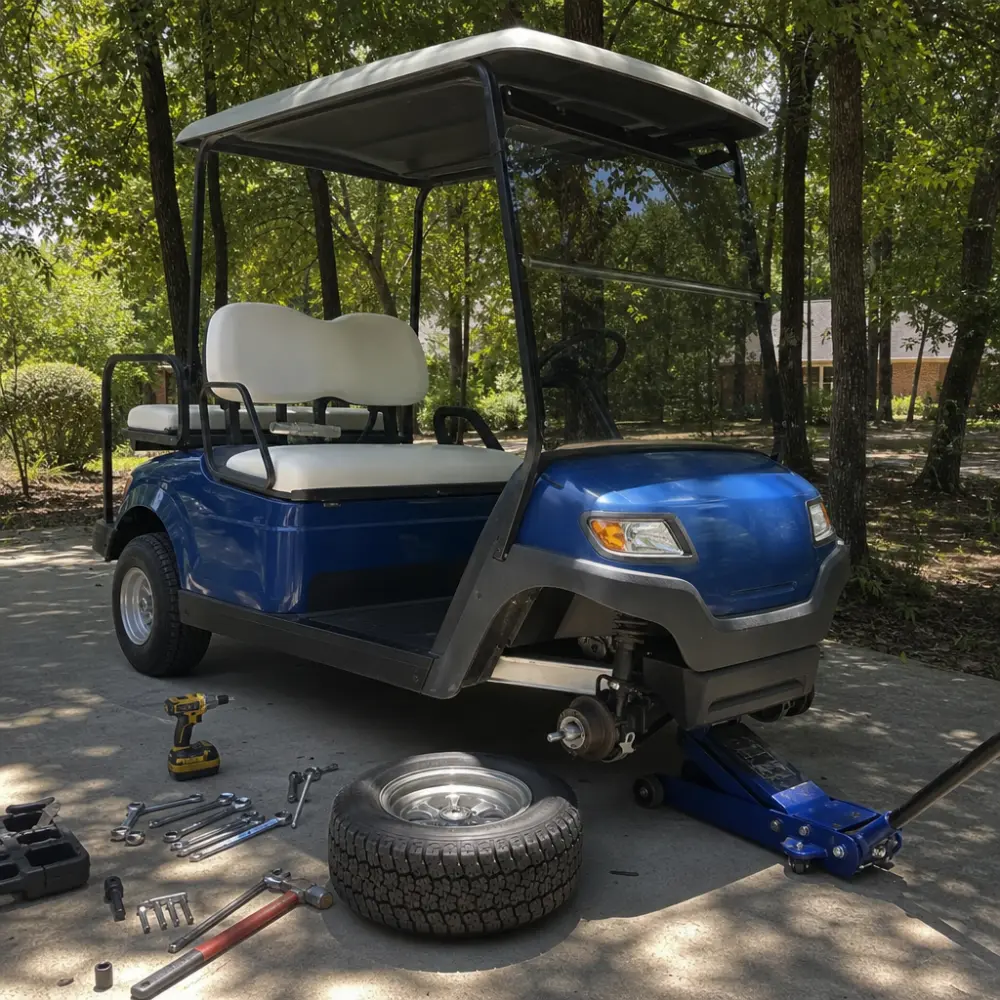
- Brakes and tires: adjustments, shoes, drums, parking brakes, and tires.
- Motor and controller repair: solenoids, speed controllers, key switches, and motors, metered before anything is swapped.
- Charger repair: chargers, charge ports, and the cart that “will not take a charge.”
- Tune-up service: a seasonal check for electric and gas carts, timed before the first freeze.
- Lights and street-legal equipment: headlamps, tail lamps, reflectors, horn, reverse beeper, and mirror, built to the Georgia PTV list.
Every price range is on the pricing page.
What Griffin’s weather does to a cart
Griffin’s weather works on a battery from both ends of the year. The NOAA climate station at Experiment, about a mile and a half from the center of Griffin, records an average of 39.1 days a year at 90°F or hotter and 51.8 nights a year at or below freezing, based on the 1991 to 2020 normals.
- Summer heat. July averages a high of 89.8°F at that station. Heat evaporates water from flooded lead-acid batteries, and plates left uncovered sulfate and lose capacity for good. Watering on schedule is the cheapest battery insurance there is.
- Winter cold. January averages a low of 34.3°F. A lead-acid pack delivers less range when it is cold, and a cart parked for the winter on a half charge sulfates while it sits. A cart that “died over the winter” is not always a dead pack. The after-winter page walks through what to check.
- Rain all year. The same station averages 54.19 inches of precipitation a year, and every month gets between 3.31 and 5.27 inches. There is no dry season for a garage to air out, so terminals and charge ports corrode year round, and a corroded connection looks just like a weak battery.
Lights are not optional in Griffin
Most golf cart owners think of lights as an accessory. In Griffin they are the law. Section 90-214(h) of the city code says a PTV’s head lamps and tail lamps must be on at all times on public roads, and Section 90-217 requires head lamps, tail lamps, reflectors on the front, rear, and sides, a horn, a rearview mirror, a reverse warning device, a main power switch, a parking brake, and hip restraints and hand holds. When you register, the city’s form says you are verifying that the cart meets the state equipment list in O.C.G.A. 40-6-330.1.
That has two repair consequences. First, a failed lamp, horn, or reverse beeper is a citation risk, not just an annoyance; Griffin’s penalties against the owner run up to $250 for a first offense. Second, running lights for every mile adds a steady electrical load, which shortens range on a tired pack and makes clean connections matter more. The lights and equipment page prices the work.
Sun City Peachtree carts
Sun City Peachtree is a 55 and older active adult community off Jordan Hill Road and Teamon Road, where construction began in 2007 and homes are built in neighborhoods called pods. It sits outside Griffin’s city limits, so it falls under Spalding County. The residents’ own website says golf carts must be driven by someone with a valid Georgia driver’s license who follows the same rules of the road as cars, and that carts are not allowed on the golf course cart trails or the walking paths. Spalding County’s 25 mph subdivision speed limit lists Sun City Peachtree by name. A cart used for short, frequent trips at low speed is easy on its motor and hard on its brakes, its tires, and any pack that rarely gets a full recharge. The Sun City Peachtree page covers the community in detail.
Beyond Griffin and Sun City Peachtree, service also reaches Hampton to the north, Locust Grove to the northeast, Zebulon to the south-southwest, and Barnesville to the south-southeast.
How a visit works
You describe the symptom, the brand, and whether the cart is 36V, 48V, or gas. A technician comes to the house at an agreed window and runs the same checks whatever the complaint: a load test on each battery, pack voltage under load, charger output at the plug, voltage drop along the main cables, then the solenoid and controller if the cart will not move. You get a firm price once the fault is found, before any work starts. The $50 to $100 service call is applied toward the repair if you go ahead.
Independent, and plain about it
This is an independent service, not an authorized dealer for Club Car, E-Z-GO, Yamaha, or anyone else. A cart under factory warranty should go back to its selling dealer. Out of warranty, the goal is the cheapest fix that actually solves the problem: a cart that will not charge gets its charger and charge port tested before anyone mentions a battery pack. More on how it works is on the about page, and the FAQ covers the questions owners ask most.
Get a quote
Send the brand, the model year if you know it, the battery count, and what the cart is doing. A photo of the battery compartment helps more than anything else. If the cart is registered with Griffin or Spalding County, mention it, because the equipment it needs depends on where it is driven.