 Griffin Golf Cart Repair
 Golf Cart Battery Replacement in Griffin
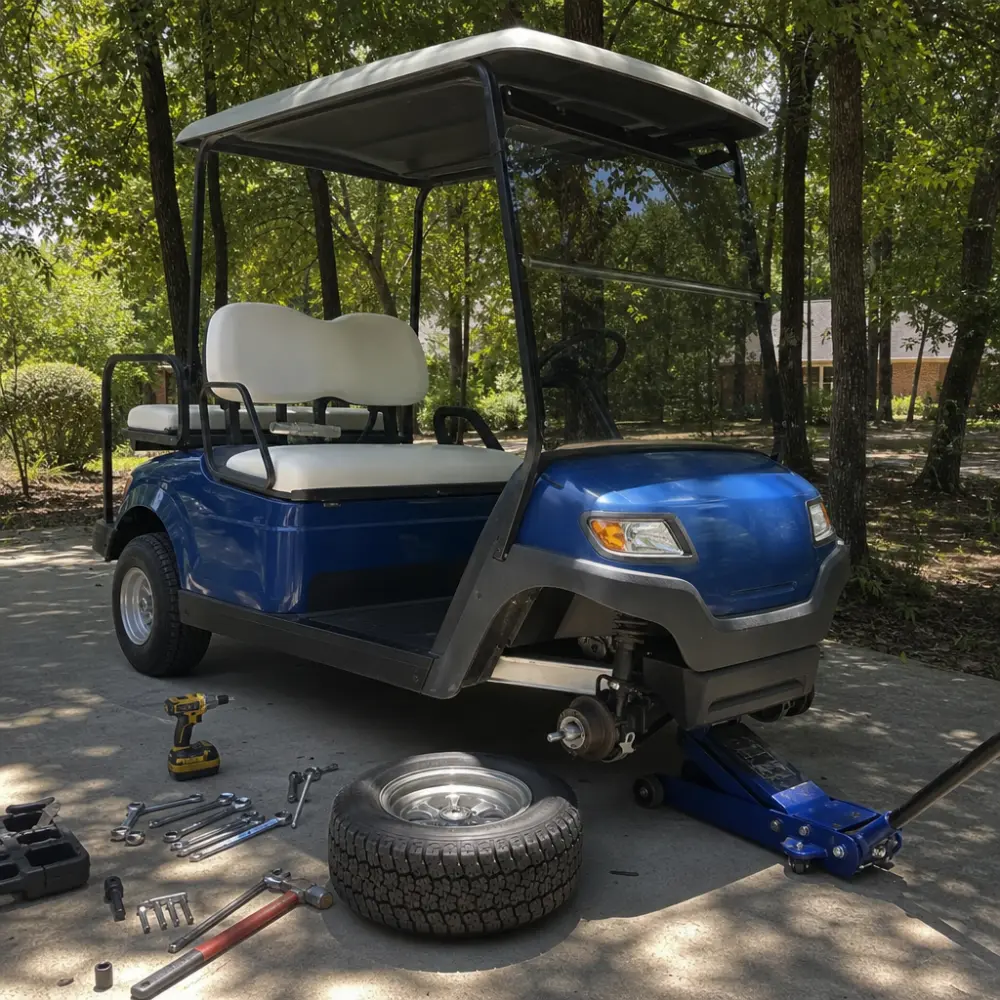
A new lead-acid pack installed at your home in Griffin typically runs $1,200 to $1,800, and a lithium conversion $1,600 to $3,500, both with the old batteries removed for recycling. Before either gets quoted, each battery is load-tested, because a corroded cable, a failed charger, or a single bad battery can make a healthy pack look finished.
Is it really the pack?
The signs of a worn pack are range that keeps shrinking, a charger that runs longer every night, and a cart that fades badly near the end of a trip. Each of those has a cheaper explanation too. A load test puts a real current draw on each battery and watches how far its voltage falls; on a flooded pack, a hydrometer reading on every cell adds a second opinion. If one or two batteries are bad on a pack under about two years old, replacing just those can be the right call. On an older pack, a single new battery gets pulled down to the level of the tired ones around it.
Lead-acid prices
| Pack | Typical installed price |
|---|---|
| 36V, six 6-volt batteries | $1,200 to $1,600 |
| 48V, six 8-volt or four 12-volt | $1,400 to $1,800, premium flooded brands at the top |
Installation includes the batteries, inspection and coating of cables and terminals, a full watering on flooded batteries, hold-downs tightened, and a test drive.
Lithium prices
| Pack | Typical installed price |
|---|---|
| 48V, 50 to 60Ah | $1,600 to $2,200 |
| 100Ah and up | $2,500 to $3,500 |
A conversion includes a charger built for lithium, since a lead-acid charging profile is wrong for a lithium iron phosphate pack. The trade is a higher price up front for no watering, much less weight, and steady power to the end of the charge.
What Griffin’s climate does to a pack
The NOAA normals station at Experiment, about a mile and a half from the center of Griffin, puts both ends of the year in the numbers (1991 to 2020 normals):
| Measure | Value | What it means for a battery |
|---|---|---|
| Days at or above 90°F | 39.1 a year | Faster water loss from flooded cells |
| July average high | 89.8°F | Peak watering season |
| Nights at or below 32°F | 51.8 a year | Less usable range on cold mornings; risk for a pack stored half charged |
| January average low | 34.3°F | The coldest month |
| Annual precipitation | 54.19 inches | Damp garages year round, so terminals corrode |
Heat and cold do different damage. Heat cooks water out of a flooded battery, and plates left above the electrolyte sulfate and lose capacity for good. Cold does not hurt a fully charged pack much, but a pack that sits through December and January at half charge sulfates slowly, and a deeply discharged lead-acid battery is more likely to freeze than a charged one. The practical rule for a Griffin cart is simple: water it through the summer, and never park it for the winter less than fully charged.
Street-registered carts need a stronger pack
A cart registered with the City of Griffin must run its head lamps and tail lamps at all times on public roads (Code of Griffin Sec. 90-214(h)). That is a steady electrical load on top of the drive motor, every trip. A pack that still feels fine on a private driveway can leave a street-registered PTV short of range. If you are registering a cart for city streets, a load test on the pack first is money well spent. The lights and street-legal equipment page covers the lamps themselves.
Lead-acid or lithium for your cart?
- Daily driver around Sun City Peachtree or a Griffin neighborhood: lithium often wins on total cost over its life, provided cold-weather charging is handled.
- A few trips a week, stored in a garage: a quality lead-acid pack at $1,200 to $1,800 is usually the better value.
- Cart that sits for months: either chemistry needs a plan for storage; lead-acid needs a maintenance charger, lithium needs the right state of charge per its maker.
The battery cost calculator prices each combination.
After the new pack goes in
Check flooded batteries every two to four weeks in the hot months and every six to eight weeks in the cool ones, using distilled water and filling after a full charge. Recharge after every use. Before the first hard freeze, charge fully and keep a maintenance charger on through the winter. The tune-up service folds all of that into one seasonal visit, and the range dropping page explains how to spot early pack wear. Full prices are on the pricing page.
Frequently Asked Questions
How much does a golf cart battery pack cost in Griffin?
A lead-acid pack typically runs $1,200 to $1,600 installed for a 36V six-battery set and $1,400 to $1,800 for a 48V set. Lithium conversions typically run $1,600 to $2,200 for a 50 to 60Ah pack and $2,500 to $3,500 for 100Ah and up.
My cart lost range over the winter. Do I need new batteries?
Maybe not. Lead-acid capacity drops in the cold and comes back as it warms, so a short-range cart in January is not proof of a dead pack. A pack stored on a partial charge, though, can sulfate permanently. A load test after a full charge tells the two apart.
Will lithium work in an unheated Griffin garage?
Lithium handles the cold better than lead-acid for driving, but many lithium packs will not accept a charge below freezing, and Griffin averages 51.8 nights a year at or below 32°F. Ask how the pack's battery-management system handles cold charging before you buy.
What happens to the old batteries?
They are taken away for recycling as part of the installed price. Lead-acid batteries are recyclable and should never go in household trash.